A proof-of-concept of borrowing crypto-assets against the ownership of a gold bar that never leaves the vault — now inviting partners. An autonomous AI agent tackling the gold-price "oracle problem" is also live. To be presented at AUTON Demo Day 2026.
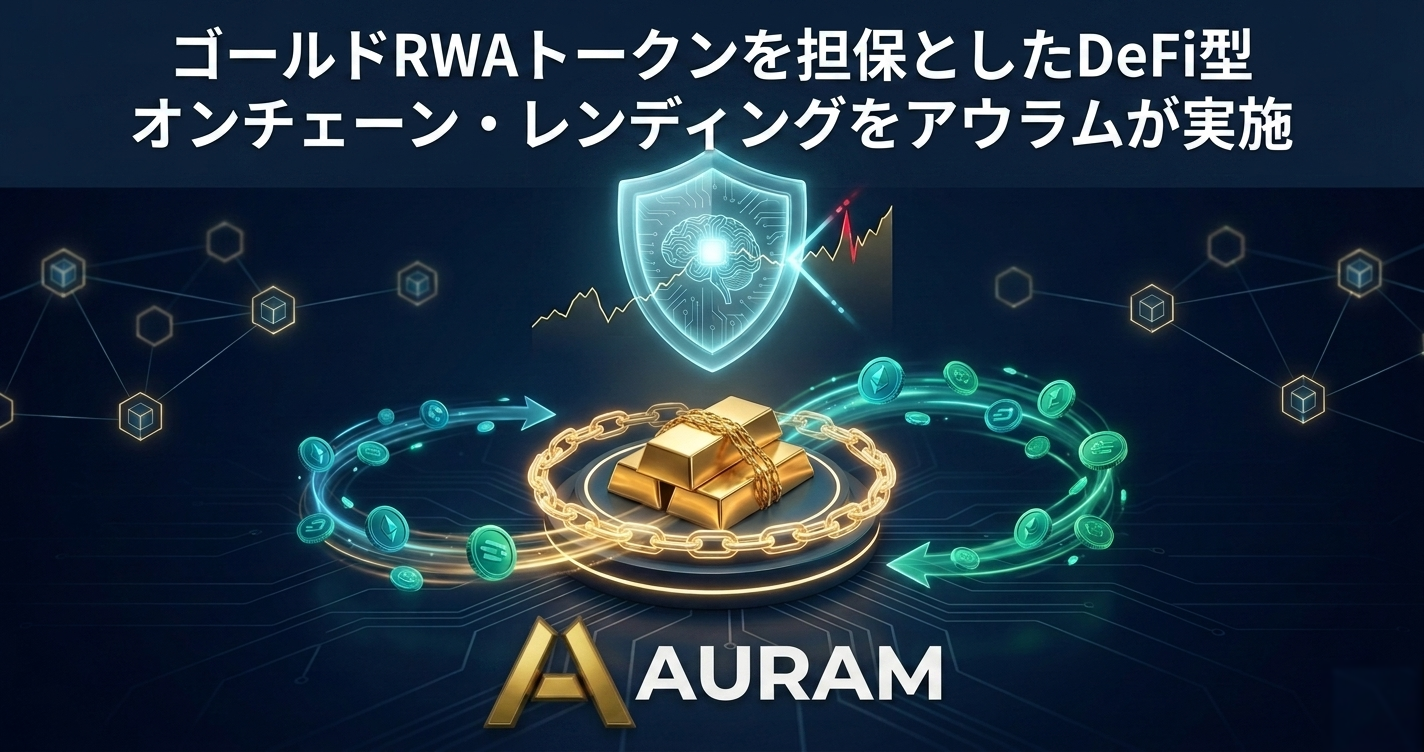
AURAM Inc. (head office: Chuo-ku, Tokyo; Representative Director: Kazuhiro Fukuda; "AURAM") is a startup developing a "movable-asset digital ledger" that records the transfer of ownership and the collateral status of real-world assets on a blockchain — without moving the physical asset — so that third parties can independently verify them while the holder's privacy is protected. Using its in-house movable-asset digital ledger platform "AURAM," which records and manages the ownership attribution of movable assets such as gold bars as NFTs on a blockchain, we have conducted a proof-of-concept (PoC) of DeFi-style on-chain lending in which crypto-assets (WAVAX) are lent against that ownership NFT as collateral.
This PoC was carried out as a project selected for the "AUTON Agentic Economy Accelerator Program 2026," an accelerator focused on the convergence of AI agents and DeFi (decentralized finance), and we will present the results at the Demo Day held on Monday, July 13. Toward commercializing this technical foundation, AURAM is now inviting financial institutions working on loans in Japanese yen or stablecoins collateralized by gold RWA tokens, as well as businesses interested in partnering on crypto-asset lending.
Highlights
1. Demonstrated an on-chain lending scheme collateralized by the ownership of a gold bar: From setting collateral on a gold bar using Article 184 of the Japanese Civil Code ("transfer of possession by instruction") to lending crypto-assets (WAVAX) against the ownership NFT, through repayment and release of the collateral, the entire cycle was implemented and recorded on a public blockchain — while the physical bar never left the vault.
2. Developed "Oracle Guardian Agent," an AI agent that detects and responds to the gold-price "oracle problem": An autonomous AI agent that monitors and halts price-oracle anomalies without human intervention is now live on the demo site of our gold-bar trading platform "KINGOT." It is a concrete implementation of the AI × DeFi vision championed by AUTON.
3. Started recruiting partners toward commercialization: We are seeking collaboration with financial institutions working on yen-denominated loans collateralized by gold bars, and with businesses engaged in crypto-asset lending.
Background
Gold prices have risen roughly fourfold over the past five years, and demand for gold as a safe-haven asset is growing worldwide. Meanwhile, the means to put the value of held gold bars to work remain scarce — and the institutional environment for RWA and on-chain finance that could unlock them is rapidly taking shape. This PoC was conducted precisely where this "sleeping asset" meets a "policy tailwind."
Why does the value of gold bars lie dormant?
With inflation persisting globally, concern is growing about the erosion of the real value of cash holdings. Gold, a real asset resilient to inflation, is attracting renewed attention as a hedge, and more asset-management companies and operating companies now hold gold bars. Yet the means to utilize the value of those holdings are limited. Selling triggers corporate tax on capital gains, which fails the needs of owners who want to raise funds without realizing unrealized gains. Real estate benefits from a registration system that institutionalizes collateralization and transfers of rights, but no such public registration system exists for movables like gold bars. As a result, when financial institutions provide asset-based lending (ABL) against movables, identifying, valuing, and continuously managing the collateral is costly, and the burden of screening and procedures puts such loans out of reach for small and mid-sized companies.
RWA tokens and on-chain finance: a policy tailwind
RWA (Real World Assets) refers to the concept of tokenizing physical assets — real estate, precious metals, bonds, and so on — on a blockchain, enabling digital trading, management, and use as collateral. The market is growing rapidly worldwide. Bonds and real estate currently lead the way, but gold-backed RWA tokens, with their superior liquidity and price transparency, are expected to expand as well.
In Japan, the proposal "Digital Nippon 2026," compiled in May 2026 by the Liberal Democratic Party's Digital Society Promotion Headquarters, includes recommendations from its "Next-Generation AI and On-Chain Finance Vision Project Team" calling for the promotion of on-chain finance and the strengthening of Japan as an asset-management nation through RWA tokenization. The recommendations set out a policy of enhancing the connectivity between assets and currencies through on-chain loans collateralized by tokenized RWAs. In addition, the draft of the "Basic Policy on Economic and Fiscal Management and Reform 2026 (Honebuto Policy 2026)," published in June 2026, explicitly mentions "promotion of on-chain finance."
This PoC is a concrete technical demonstration of RWA-collateralized on-chain lending in line with this policy direction. Gold bars are physical assets whose market prices are continuously published — making valuation objective and clear — and which are highly liquid in a single global market. We believe this PoC moves the social implementation of on-chain finance through RWA tokens one step forward.
About the AURAM Platform
"AURAM" is a "movable-asset digital ledger" platform that records and manages the ownership of real-world assets such as gold bars as transfer-restricted NFTs (a proprietary implementation referencing ERC-721). By implementing Article 184 of the Civil Code ("transfer of possession by instruction") on-chain, we have built a mechanism that securely transfers only the ownership of a gold bar stored in a vault, without physically moving it (patent pending). The recorded NFTs are published on a public blockchain (the Avalanche Fuji testnet) and can be viewed and verified by anyone.
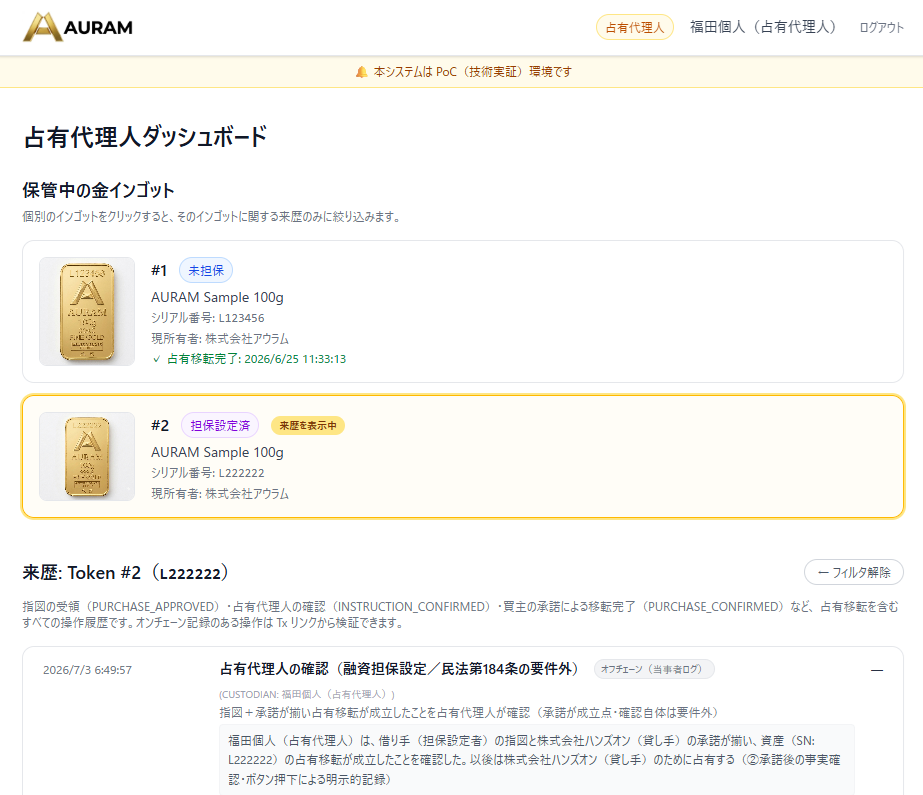
In this PoC — a first for the company — the AURAM NFT recording the ownership attribution of a gold bar is locked and released on a smart contract, implementing and recording the process of setting and releasing collateral without moving the physical asset. It extends our technical foundation from trading to collateral and lending. The press release we published in June 2026 (below) explains the platform in detail, including the allocated-custody legal structure in which the customer continues to hold ownership (a real right), and the privacy design that records only individual-identification hash values on-chain. Please refer to it as well.

▶ AURAM Conducts a Proof-of-Concept for Transferring Gold-Bar Ownership Without Moving the Bar from the Vault — Now Inviting Trading & Custody Partners (June 29, 2026)
Participation in the AUTON Program and Invitation to the "AUTON - Agentic Economy Accelerator Program - Demo Day"
AURAM was selected for the "AUTON Agentic Economy Accelerator Program 2026," jointly hosted by five companies — SMBC Nikko Securities Inc., the University of Tokyo Innovation Platform Co., Ltd. (UTokyo IPC), Fracton Ventures Co., Ltd., Next Finance Tech Co., Ltd., and Prime Beat Inc. — and has advanced technology development and business validation over roughly three months with the support of the program's mentors. The program aims to create a new economic sphere through the convergence of decentralized finance (DeFi) and artificial intelligence (AI).
At the Demo Day on Monday, July 13, we will present the results with a detailed demonstration of this PoC and a presentation by our Representative Director, Kazuhiro Fukuda. Individual consultations on partnerships toward commercialization will also be available. We look forward to welcoming financial institutions and crypto-asset businesses.
| Event | AUTON - Agentic Economy Accelerator Program - Demo Day |
|---|---|
| Date & time | Monday, July 13, 2026, 13:00–17:00 (doors open 12:30) |
| Venue | HOOPS Link (Shin-Marunouchi Building 15F, 1-5-1 Marunouchi, Chiyoda-ku, Tokyo) |
| Admission | Pre-approval required (advance registration). Due to venue capacity, attendees will be selected from registrants and notified by the secretariat by around July 10. |
| Registration | https://luma.com/6e6pde5i |
Overview of the Proof-of-Concept (PoC)
Objective
Using an NFT recording the ownership attribution of a gold bar as collateral, we executed a loan of crypto-assets (WAVAX) while the physical bar remained in the vault. The main focus was to confirm that the full cycle — setting collateral, lending, repayment, and releasing collateral — can be implemented and reproduced on a blockchain as a tamper-resistant, independently verifiable record. This PoC verified the technical and legal structure on the premise that AURAM owns the gold bar in question; it involves no transfer of physical ownership and no legally effective creation of a security interest (the WAVAX was actually exchanged on-chain). For technical verification purposes, it was conducted between two companies both represented by our Representative Director, Kazuhiro Fukuda (HANDS ON Inc. as lender and AURAM Inc. as borrower), as a first stage; going forward, we will advance verification involving independent third parties with no capital or management ties.
Transaction Flow
With a 100 g gold bar kept in the vault, we reproduced the creation of collateral based on Article 184 of the Civil Code ("transfer of possession by instruction").
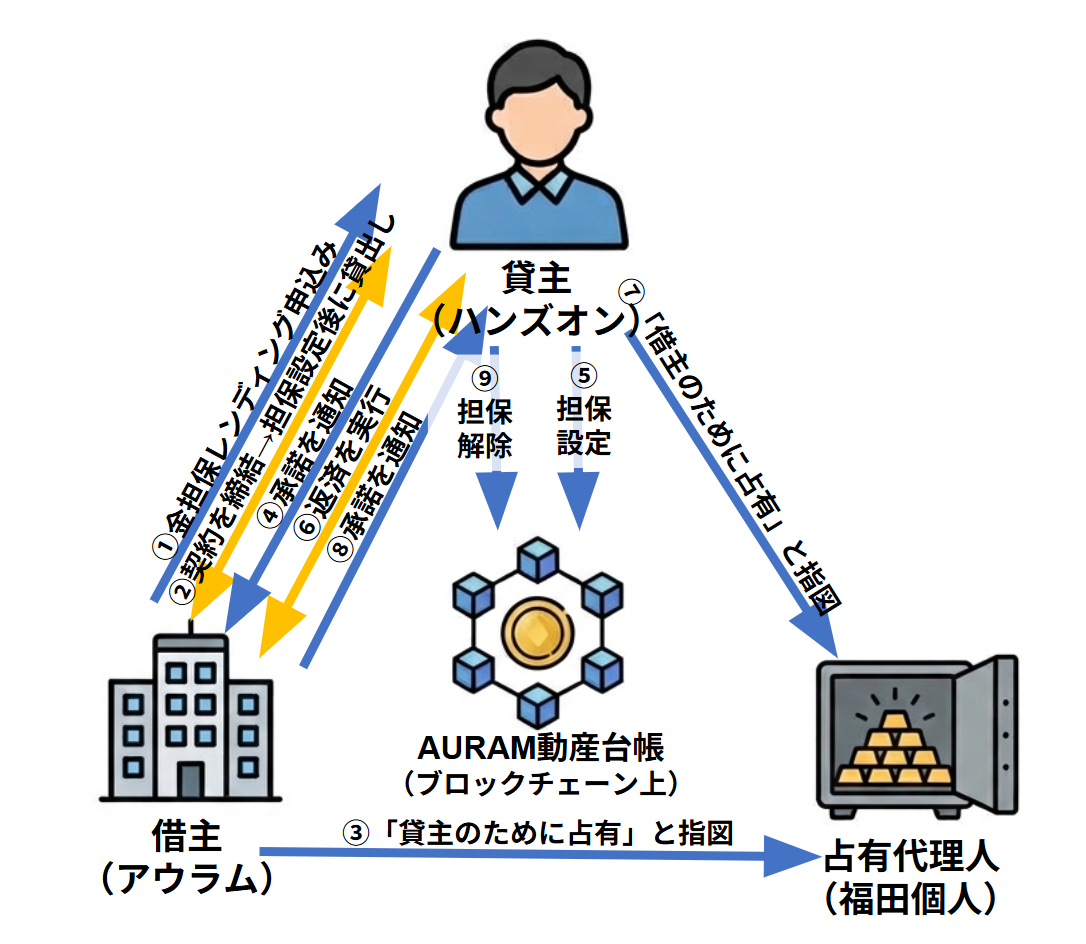
The owner's (borrower's) instruction and the secured party's (lender's) acceptance were each recorded on the blockchain; the ASSET NFT (a transfer-restricted proprietary implementation) was pledged as collateral, its status updated to "Collateralized," and locked on the smart contract. Following price confirmation, the WAVAX loan was then executed, and the full cycle — collateral submission, lending, repayment, and collateral release — was recorded on the public blockchain. While the WAVAX was actually exchanged, the physical ownership of the gold bar used as collateral was never transferred.
| Collateral asset | One gold bar (100 g, 999.9, demonstration sample) |
|---|---|
| Ownership NFT | AURAM ASSET NFT (transfer-restricted) |
| Loan asset | AVAX (WAVAX) / loan amount: 1 AVAX |
| Loan period | One day (repaid the next day) |
| Blockchain used | Avalanche Fuji testnet |
| Lender | HANDS ON Inc. |
| Borrower | AURAM Inc. (assumed owner of the gold bar) |
* The bar images and the engraved information (manufacturer name, serial number, etc.) registered and published in this PoC are all demonstration samples and do not represent products of any actual manufacturer. In the production service, the photos and engraving information of the actual physical item being registered will be used.
Development of the Autonomous AI Agent "Oracle Guardian Agent"
Both gold-bar trading and collateralized lending fundamentally depend on prices being obtained correctly. If a price oracle fails, stalls, or reports anomalous values while trading continues, collateral valuations go wrong and users can be harmed (the blockchain "oracle problem"). AURAM developed "Oracle Guardian Agent," an autonomous AI agent that monitors and halts this fundamental risk without human intervention, and put it into operation on the demo site of our gold-bar trading platform "KINGOT." Its price-monitoring status can be checked by anyone in real time on the public "Oracle Deviation Monitor" page (no login required).
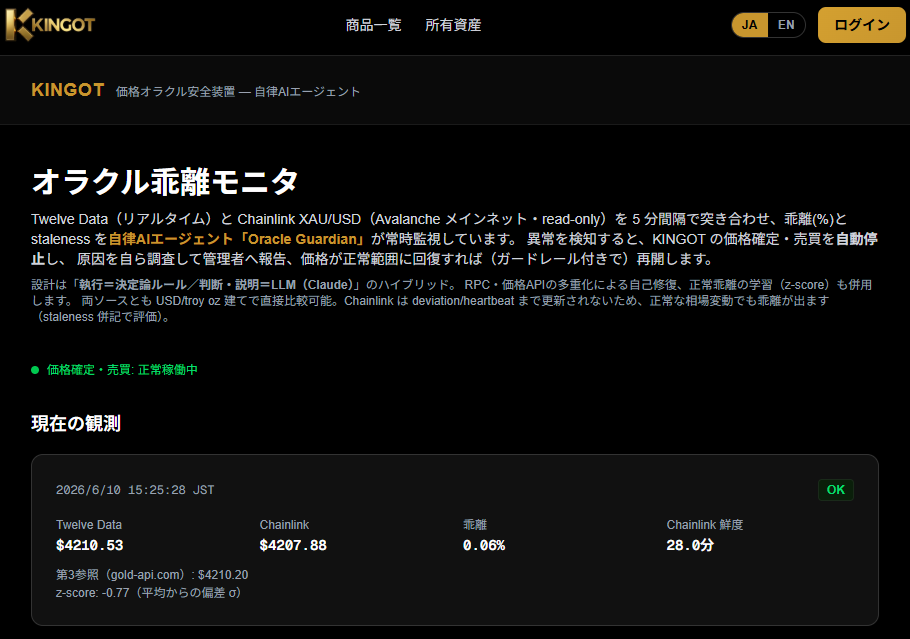
Key functions (excerpt):
1. Price-oracle safety mechanism: Gold prices from Twelve Data (real-time) and Chainlink XAU/USD (referencing the on-chain price feed) are continuously cross-checked. When a deviation or a stalled update is detected, price fixing and trading are automatically suspended until safety is confirmed.
2. Autonomous root-cause investigation by an LLM: On suspension, an AI (Claude Opus 4.8) investigates each price source, RPC, chain status, and web sources on its own, classifies the cause (genuine price spike / feed failure / API or RPC outage, etc.), and generates an individual report.
3. Hybrid design — execution by rules, judgment and explanation by LLM: AI non-determinism is kept out of the financial circuit breaker: the "halt and resume" safety valve is governed by deterministic rules, while only root-cause analysis and explanation are delegated to the AI.
4. Guarded automatic resumption: When conditions recover, low-risk cases resume automatically; high-risk cases (ambiguity, equipment failure, etc.) require human approval.
Every decision is recorded as reasoning logs and audit logs, ensuring accountability and enabling post-hoc verification. This capability is one of the foundational technologies supporting the reliability of the "on-chain finance collateralized by real-world assets" that AURAM aims for, and a concrete implementation of the AI × DeFi vision championed by AUTON.
How to View the NFT and Smart Contracts
The state of the NFT on the AURAM movable-asset ledger, which recorded this PoC from collateral creation to release, can be viewed and checked by anyone on the following public pages.
▶ AURAM Movable-Asset Digital Ledger — Public Status
▶ Third-Party Verification Guide (steps anyone can follow to verify independently)
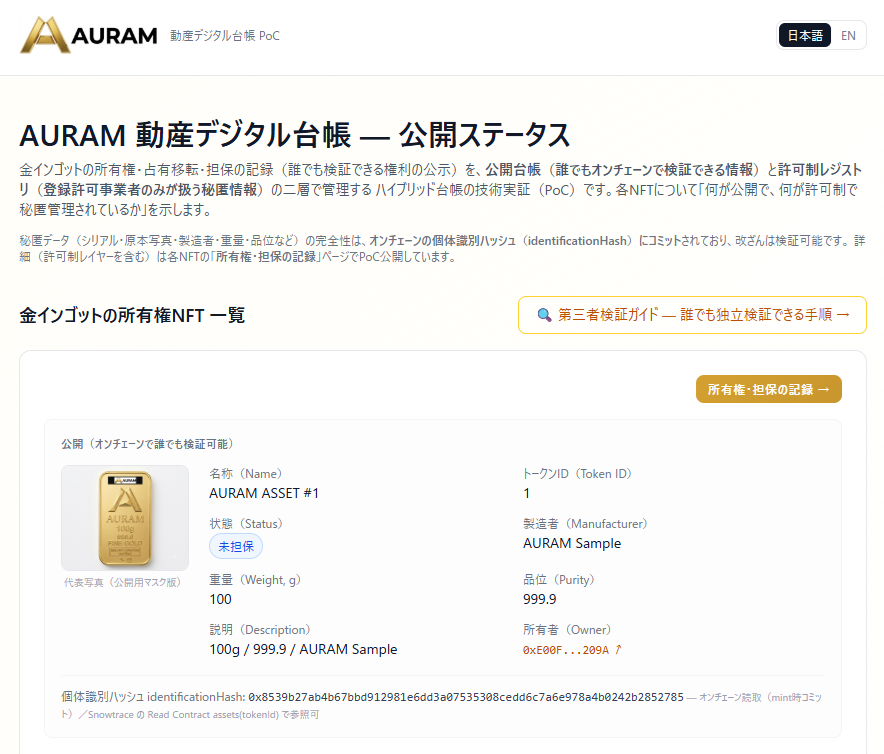
Each NFT records on-chain an individual-identification hash (identificationHash) computed from five elements: manufacturer, serial number, weight engraving, purity engraving, and photo hash. The originals (serial numbers, original photos, etc.) are managed in a permissioned registry; only wallet addresses and hashes not linked to real names are made public. The complete transaction history — including collateral locking, repayment, and collateral release — is published in a tamper-resistant form.
Regulatory Position
We take the position that lending crypto-assets (AVAX) does not constitute a "loan of money" under Japan's Money Lending Business Act. In addition, the NFTs issued on AURAM are transfer-restricted by smart contract and cannot be freely transferred or traded on secondary markets outside the platform. This transfer-restricted design is also consistent with the direction of compliance-oriented on-chain finance (DeFi-R / CeDeFi), which limits participation to KYC-verified addresses and transfer-restricted tokens. The NFT is a record on the "movable-asset digital ledger" that documents ownership attribution; the NFT itself is not an object of trading.
On this point, we consulted the FSA FinTech Support Desk and — premised on our explanation — received the view that this NFT is considered to fall under neither collective investment scheme interests nor crypto-assets.
Partner Recruitment: Toward Commercialization
Through this PoC, we confirmed the effectiveness of a technical foundation that uses gold RWA tokens as collateral assets. Toward commercialization, AURAM is now recruiting partners in the following areas.
For financial institutions: yen-denominated loans collateralized by gold bars
For yen-denominated secured lending against gold bars (ABL — asset-based lending on movables), we propose using the AURAM movable-asset ledger as the collateral-management infrastructure, adaptable to various collateral structures. Combining tamper-resistant, third-party-verifiable publication of ownership and collateral status with strict physical custody at partner vaults, it helps reduce the traditional difficulties of identifying and valuing collateral, and management costs including the prevention of double-pledging.
Looking ahead, we also envision on-chain yen lending using yen-denominated stablecoins such as JPYC and JPYSC as the loan asset, and welcome collaboration with issuers and related businesses (yen-denominated lending requires money-lending registration and similar licenses, so it is not included in this PoC; we will pursue it in the commercialization phase with a proper compliance framework).
For crypto-asset businesses: crypto-asset lending collateralized by RWA tokens
Toward commercializing crypto-asset lending collateralized by gold RWA tokens, we are exploring collaboration with crypto-asset businesses. By making the ownership NFTs issued by AURAM usable as a standard collateral asset, we will bring to the crypto-asset market a new collateral category backed by real-world assets. AURAM does not issue crypto-assets itself; we remain a neutral property-rights and collateral layer, connecting with compliant tokens issued by third parties.
We welcome inquiries from businesses interested in collaboration in any of the areas above. We will also be available to discuss details at the Demo Day venue on July 13.
Representative Profile
Kazuhiro Fukuda, Representative Director Profile page
After conducting research on multi-agent AI at Tohoku University's Graduate School of Information Sciences, he worked at Toshiba Corporation and Sony Corporation before founding his own ventures. He is a serial entrepreneur who has sold three businesses he founded through M&A.
Alongside managing businesses, as a private investor in real estate, equities, and angel investments — as well as physical assets including gold bars — he experienced firsthand the many pain points of real-asset ownership: poor liquidity, opaque provenance, and the difficulty of using assets as collateral. Convinced that "these unsolved problems can absolutely be fixed with technology and business," he founded AURAM Inc. in 2026.
About AURAM Inc.
Corporate philosophy: "Turning idle real assets into credit."
Real-world assets such as gold retain solid value over time. Yet most of them are merely held, their latent value underutilized. AURAM builds a foundation of trust: without moving securely stored physical assets, it records their ownership and collateral status on a tamper-proof digital ledger, rigorously protects the holder's privacy, and enables authorized third parties — including financial institutions — to verify authenticity whenever needed. In doing so, AURAM elevates idle real assets into "credit" that can be used as collateral without being sold, providing companies with a hedge against inflation and currency fluctuations plus liquidity, and individuals with steady asset formation.
| Company name | AURAM Inc. |
|---|---|
| Address | Nihonbashi Royal Plaza 706, 17-1 Nihonbashi-Kabutocho, Chuo-ku, Tokyo 103-0026, Japan |
| Representative | Kazuhiro Fukuda, Representative Director |
| Established | February 25, 2026 |
| Capital | JPY 5,000,000 |
| Business | Operation of a real-asset trading platform; blockchain-based recording of ownership and collateral of movable assets (movable-asset digital ledger); operation of asset-management media |
| URL | https://www.auram.co.jp/en/ |
Contact
For questions about this release or to discuss partnerships and collaboration, please feel free to reach us via the contact form.